

 English
 中文简体
 Español
 عربى
+86-13858925411 / +86-579-87721168
Lightweight cookware has become increasingly popular among home cooks who want easier handling without giving up non-stick performance. Yet a common concern remains: does lower weight mean a thinner body, weaker heat control, or a pan that feels fragile on the stovetop? The answer depends less on weight alone and more on how the body, base, coating, and handle are engineered together.
Weight Does Not Tell the Whole Story
Aluminum is widely used for lightweight non-stick cookware because its relatively low density allows manufacturers to reduce overall weight while maintaining a practical cooking surface. Consumer Reports, for example, lists non-stick aluminum frying pans ranging from around 1.5 lb to more than 2.5 lb depending on size and construction.
Such differences show why weight alone cannot determine whether cookware feels too thin. Body thickness, base construction, handle attachment, and surface treatment all influence the final experience.
- Body thickness: Thinner walls reduce weight and make lifting easier.
- Base thickness: More material around the cooking surface can improve heat stability.
- Handle balance: A well-positioned handle can make a lightweight pan feel more controlled.
- Material treatment: Hard-anodized aluminum can provide a more rigid body without relying solely on extra mass.
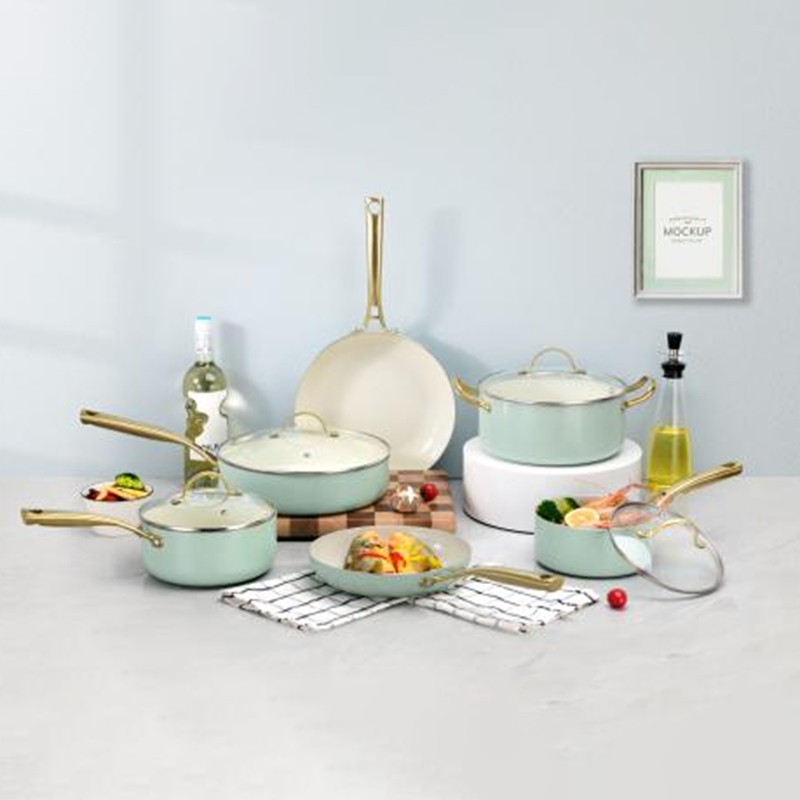
Thin Walls vs. Thin Cooking Bases
Not every thin section creates the same cooking concern. Side walls can be relatively slim while the cooking base receives additional structural support. Some cookware specifications use aluminum bodies around the 1.8–2.5 mm range, while hard-anodized designs can reach roughly 2.5–3.0 mm.
Base thickness matters because the cooking surface needs enough structural stability to resist distortion and maintain predictable heat distribution. Extremely thin construction may react quickly to a burner, yet it can also lose heat rapidly after cold ingredients enter the pan.
What Does a Balanced Structure Look Like?
- Lightweight aluminum walls for easier lifting and pouring.
- Reinforced or thicker cooking bases for improved rigidity.
- Hard-anodized surfaces for added body strength.
- Magnetic stainless-steel base layers on models designed for induction cooking.
Heat Control Can Matter More Than Heft
Cooking performance depends on how heat travels through the pan rather than simply how heavy it feels. Thin aluminum responds quickly to burner changes, which can be useful during tasks such as sautéing vegetables, frying eggs, or making pancakes. A thicker or reinforced base stores more heat and can reduce rapid temperature swings.
Recent cookware comparisons also show that manufacturers combine aluminum with other structural layers to achieve faster heat distribution while adding rigidity. Hard-anodized aluminum and clad constructions are examples of this approach.
Does Lightweight Mean Flimsy?
Flimsy cookware usually reveals itself through several details rather than weight alone. Excessive flexing around the sidewall, an unstable handle, a base that rocks on a flat surface, or visible distortion after heating can indicate insufficient structural support.
Lightweight non-stick cookware can still feel substantial when its weight is distributed intelligently. A 10-inch pan with a reinforced base and balanced handle may feel more secure than a heavier pan with poor weight distribution.
Where Lightweight Construction Makes Sense
- Daily stovetop cooking: Lower weight makes repeated lifting, shaking, and pouring easier.
- Small kitchens: Lightweight pieces are easier to move between cabinets, counters, and stovetops.
- Large frying pans: Reduced body weight becomes particularly noticeable around 10–12 inch sizes.
- Older users or frequent cooks: Easier handling can reduce wrist strain during everyday food preparation.
The Real Question: Is the Structure Balanced?
Lightweight cookware does not automatically feel too thin. The more useful question concerns whether the manufacturer has balanced weight with base rigidity, heat distribution, coating construction, and handle stability. Modern lightweight non-stick cookware can use aluminum, hard-anodized surfaces, reinforced bases, or induction-compatible layers to achieve this balance.
Shoppers comparing cookware should therefore look beyond the number on the scale. Body thickness, base design, cooking diameter, coating type, handle construction, and stovetop compatibility provide a clearer picture of how a lightweight pan will actually behave during everyday cooking.
